
Our software provides powerful support for custom domains. You can set up 1 or more custom domains for your account. This allows you to use your own domain for your various pages, webinars, meetings, etc... For example, you could use a custom domain like “mycustomdomain.com” or “webinar.mycustomdomain.com”. This is a great option if you want your potential registrants and attendees to focus all their attention on your brand.
To get your custom domain(s) set up, you can use our self service feature which we cover in detail below.
The process typically involves adding a CNAME record with your domain registrar (typically the place where you purchased your domain).
Once your custom domain is set up, your registrants and attendees will be able to access all your registration, thank you, watch room, and replay pages using your custom domain.
Viewing your domains
You can easily view all the available domains in your account by navigating to your account settings ( from the top right menu ), and navigating down to the "Custom Domains" section. From here you can see a list of all the custom domains added to your account. To see how to add custom domains to your account, see the sections below.

Setting up a custom domain
First, make sure you have a custom domain available in your account. Some plans come with a custom domain, but if yours does not, you can always purchase additional custom domains here. Once you have a custom domain available, goto your account's settings and navigate to the Custom Domains section. Then click "Add domain" in the top right corner.

In the popup that appears, enter the domain you want to add to your account (e.g. "mydomain.com" or "webinar.mydomain.com") then click the "Generate CNAME record" button.
Please note: Root level domains like "mydomain.com" are typically a bit more involved to setup and may prevent your website from loading if you're already using it. So we generally recommend using a subdomain like "webinar.mydomain.com" as the process is usually much simpler and prevents potential complications. With that said, if you prefer to use a root level domain, we'll cover how below.

After generating your CNAME record, you'll be shown the name and target that you'll need when adding the CNAME record to your domain's DNS settings.

Adding a CNAME record to your domain's DNS settings
Please note: Many domain registrars / DNS providers do not let you enter a CNAME record for "root level" domains. So if you want to use a root level domain (e.g. "mydomain.com"), you may need to use a different DNS provider to configure your domain. We highly recommend CloudFlare (https://cloudflare.com) in these situations because it is easy to use and free. If needed, set up your free CloudFlare account, add your domain to the CloudFlare account, then point your domain's nameservers at CloudFlare. Once this process is complete, you can add the CNAME record to your domain's DNS settings in CloudFlare.
Start by navigating to your domain's DNS settings. You should see an option to add a CNAME record. Select that option and then when prompted for the Name / Host / Alias, enter the "Name" previously generated. When prompted for the Target / Value / Points to, enter the "Target" previously generated.

If your DNS provider offers a "proxy" option, we generally recommend leaving it off. If your DNS provider shows a TTL (Time to live) option, any setting will work.
Save the CNAME record and return to your WebinarKit account's settings page.
Complete the custom domain setup process
After adding the CNAME record to your domain's DNS settings, navigate to the Custom Domains section in account's settings page. Find the custom domain you just added, click the "Manage" dropdown link next to your domain, and then click "Refresh domain".
Once that is done, your custom domain should be all setup and you should be able to navigate to it in your browser within just a few minutes. If the page loads successfully (it will load the sign in page by default), that means your custom domain is setup correctly.
Please note: If you see an error message when visiting your custom domain in the browser, it might just mean more time is required for the settings to propagate. Wait a few more minutes, click the "Refresh domain" option again, and then try seeing if your domain is working once more. In some rare cases, it may take several hours for the DNS settings to propagate.
Setting your custom domain's home page redirect
By default, when navigating to your custom domain's home page (e.g. https://mydomain.com), it will redirect to your webinars dashboard page (e.g. https://mydomain.com/webinars). But you can customize the redirect to be any link you want effectively allowing you to set your home page to anything you want.
For example, you could set your home page redirect to be a webinar registration page, a sales page, an "about us" page, etc...
To tweak your redirect settings, simply click on the "Manage" option next to your custom domain as shown in the screenshot above and follow the prompts to update your domain's redirect link.
Setting your default domain
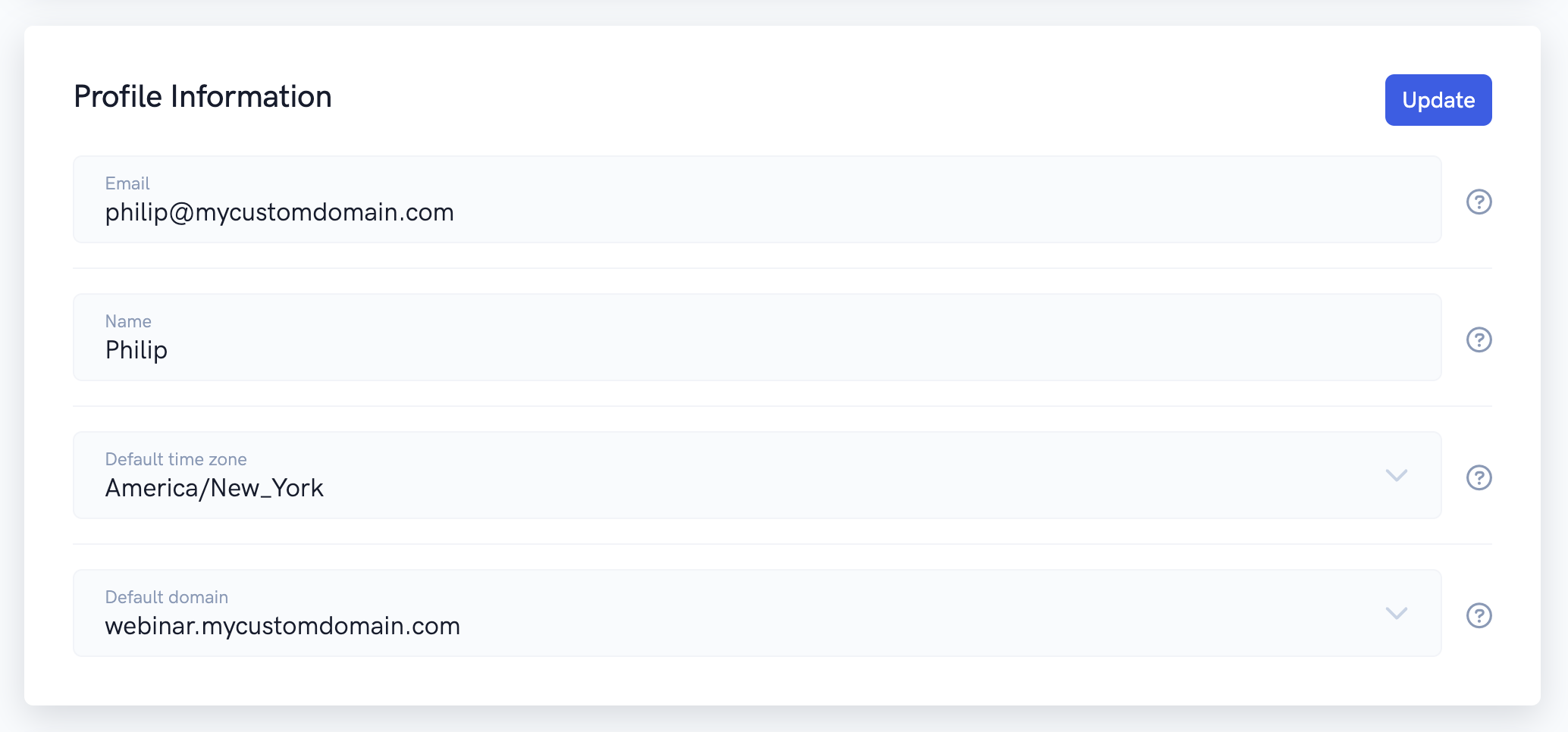
You can also specify the default domain for your account. For example, if you set your default domain to be one of your custom domains instead of "webinarkit.com", new events and subaccounts that you create in your account will start off using your custom domain. If you update your default domain, be sure to click the "Update" button to save your settings!
Changing an event's domain
If you want one of your events to use a specific domain that's different from the default domain (shown above), simply navigate to your event's "Details" settings page and scroll down to the "Domain" section.

Click on the "Edit" button and from the dropdown select the domain you'd like your event to use. Then, save your settings and that's it!

Now when you get your event links from the dashboard, the links will be using the domain you selected and all leads, registrants, and attendees will be seeing your custom domain!
Custom domains for subaccounts
If you are a white label customer, you can set up custom domains for specific subaccounts. You can setup your custom domains to work across one or more subaccounts. In order to setup additional custom domains for particular subaccounts, please contact our support team.